After banging my head against my computer for a frustrating morning, I finally got the latest revision of the cards prepped as a PDF and set on the site! You can download them on the left, or by clicking here!
Now there's a common thread through the phraseology of the verse rules, the Mastery challenge DISCARD effect is now in place, and it's all ready!
Soooo....
Pleeeeeze give it a try and start playtesting it! Let me know how it all goes. It is a bit intimidating to print and cut apart all of those cards. There are 143 cards, and each one is a set of six on its own page. I haven't yet figured out how to merge my database to flow them so that there are six unique cards on each sheet.
But, you can print them all out, then cut one off of each sheet, and you'll have enough to play. Then, if you cut them all out, you'll also have enough that two people could make unique decks and test your deckmaking, so the error does have its advantages. I also recommend that you put the verses into plastic sleeves (available dirt cheap at hobby stores and card shops), so that they're easier to shuffle!
Thanks so much for giving it a try!
Mark has a lifelong testimony of the Church of Jesus Christ of Latter-Day Saints (the Mormon Church). Mark also has other sites and blogs, including MarkHansenMusic.com and his Dutch Oven blog.
Every once in a while, things will bubble and boil up inside me, and all of the ideas that I've had over the course of six months or a year will all burst forth into... What? Stew?
I don't know where I was going with that metaphor.
But anyway, I just finished reworking the rules. There are two big differences:
I did away with the learning game and the standard game. I found that when I taught people the game, I taught the standard game, anyway. I also combined the meta game into the shame rules doc as the standard game. The mastery game is so far from development that I shelved it, too. I also created a "Quick Start Guide" so that players can get the overall idea of the game, and give it a try, then reference the more detailed rules to answer questions, or as they get more into the game.
I did away with the "Quote Challenge" rule, and made it a DISCARD verse rule. I found that many people testing the game were turned off by the rule, and by playing the game with the possibility of a challenge hanging over their heads. Making it a verse rule follows the model of the Magic: The Gathering "Cancel", "Counter", and "Fizzle" spells.
Here in a few days, I'll put out the new cardset, too. It has more verses, about 145, and my playtests so far have been lots of fun.
Mark has a lifelong testimony of the Church of Jesus Christ of Latter-Day Saints (the Mormon Church). In addition to playing LDS games, Mark also has other sites and blogs, including MarkHansenMusic.com and his Dutch Oven blog.
Recently, I got a facebook message from one of my old buddies from my high/school college days. He was one of our gamer crowd, and played a lot of D&D as well as other miniatures and role-playing games.
He’d developed a game, with a prototype, that he wanted me to playtest. It was based on the old, corny B-grade horror flicks of the past. The premise is a bunch of students spending the night in a mansion with a monster. They have until midnight to 1) identify and kill the monster using weapons and items they find, 2) escape the island the mansion is on, or 3) die trying.
Our family tried it, and it was a hilarious and silly romp. It’s a cooperative game, so we were all trying to win together.
Afterward,. by a few days, I got on the phone with him and we talked a lot of cool things about game design and our game efforts. It was interesting to talk to him about Chapter and Verse, and about Dr Grimdeath, because he’s not LDS, and so that made it interesting to explain the concepts of the game.
I thought I’d share some highlights of our discussion, because it plays not only into LDS gaming, but also into game design in general. I’ll touch on each one here, in the successive parts of this posting!
Feedback Loops
There are two kinds of feedback loops in game design. A “Positive Feedback Loop” is a rule or a circumstance that encourages a situation to recur more and more frequently. One broad example, it’s the way a Monopoly game is really won or lost in the first few turns. The player that gets the best properties in the first few rounds ends up collecting more rent, and that grows into more re-investment, until he or she is unstoppable. You have to watch for these in your games, or they can make the game balance run away from you.
A “Negative Feedback Loop” is a rule or situation that makes a situation LESS likely to recur. In American Football, when you score a touchdown, you have to kick off to the opposing team, and it’s their turn to be on the offensive.
It’s important to note that the terms “Positive” and “Negative” don’t refer to any thougths about the outcome. As a player a PFL can have a very bad impact on my strategies and my play of the game, and a NFL can keep my opponents in check. Positive loops are things MORE likely to happen again, and negative loops are things LESS likely.
Early in the game, when a player closed up a book, he/she would draw blessing verses, and then continue on with their turn. I soon discovered that players could use various drawing verses (like Prayer and Keyword) effects to just keep on playing and playing, closing book after book, and win in one turn without the other player being able to do anything. A PFL was messing up the game balance. I chose to fix it like the football game. Once you close a book, your turn ends.
It’s interesting because in an LDS game, as in any game, you have to watch out for PFL’s because they can really mess up the balance of a game. On the other hand, in LDS LIFE, it’s full of PFLs. Like prayer, for example. You say a prayer and you feel great. You feel connected to God. That makes you want to pray more. Which makes you more connected...
Of course, temptation is also a PFL. If you give in once, you’re more likely to do it again.
Next: Getting to Your Core Essence
Mark has a lifelong testimony of the Church of Jesus Christ of Latter-Day Saints (the Mormon Church). Mark also has other sites and blogs, including MarkHansenMusic.com and his Dutch Oven blog.
I thought it would be kinda fun to talk about some of my favorite verse cards from the newest Scripture Mastery set! I keep working on the game, but I don’t always post it up here. This idea, I think will help keep me more consistent! I’m going to start with some of my favorite power cards. These verses, if the game were to ever get published would be analogous to the “rares” in Magic, or Yu-Gi-Oh. There really isn’t, unfortunately, an LDS game to compare it to, yet.
This first verse is from the New Testament: Matthew 5:14. The card quote is: “Ye are the light of the world. A city that is set on an hill cannot be hid.” It’s Pearl verse, which means that it can add one icon of any theme to the total of the chapter it’s in (like a wild card). It costs 3 to play it, and its special rules are: “Unique, ALSO, ABILITY: When you play any other verse, you may set another verse into the same chapter”
I’ve always loved this scripture. I used it in a song, in fact! It’s one of the LDS seminary Scripture Mastery verses, so it’s a good one to memorize, anyway. It comes out of the Sermon on the Mount. The Lord is telling his followers to go out and do good for the world around them. Even if the service is quiet and humble, it will be seen. It will set an example. The world will “see your good works and glorify your Father which is in Heaven.”
As I was preparing this cardset for the LDS game, I thought that good examples have a tendency to spread. If you do something good, it feels good and you want to do more. Often, it inspires others. Soon, a lot more good is getting done. As I thought about this verse, it seemed to me that light shining and cities on the hill in this sense can get things moving more quickly. So, this verse in play allows you to set an extra, additional verse each time you play one into a chapter. If I were playing it, I’d set it into an empty chapter, and use it to build up other chapters for the books and the win!
Chapter and Verse is a new kind of LDS Game! Check out the print-and-play prototype cards!
Mark has a lifelong testimony of the Church of Jesus Christ of Latter-Day Saints (the Mormon Church). Mark also has other sites and blogs, including MarkHansenMusic.com and his Dutch Oven blog.
Today, Brendon spoke in Sacrament Meeting. It was very different from the previous times he’s spoken. In the past, we worked together on his topic, and we pretty much wrote out everything he would say. This time, he researched his topic on his own, compiled his quotes and citations, lined them up in the order he wanted to, and just spoke from his notes and his mind.
Watching him up there, it made me feel really proud. Jodi said that he looked like a missionary. The talk flowed pretty smoothly all along, without any big gaps or stumbles. He didn’t even look all that nervous, even though I knew that he was feeling it that morning.
His talk was on the Godhead, and he showed some good research and understanding of the quotes and scriptures he cited. It was well-done, especially for a 15 year old.
The whole reason I’m mentioning it here is because, at the end, he cited one of my favorite scriptures: Moses 1:39 “This is my work and my glory, to bring to pass the immortality and eternal life of man”.
And, of course, since that’s one of my favorite scriptures, it was turned into one of my favorite cards. Two of my favorite cards, in fact: “The Work of God” and “The Glory of God”. One’s rule reads: “ABILITY: If this verse is in the same chapter as “The Work of God”, the chapter may be closed as a book.” The other is similar: “ABILITY: If this verse is in the same chapter as “The Glory of God”, the chapter may be closed as a book.”
So, all you need to do is to get these two verses into the same chapter, and you can close up a book. I did it this way because I felt it was interesting to think of how the Work and The Glory of god are so intertwined.
Here’s another interesting anecdote that I DIDN’T think of when I was creating the card. I made a deck with three copies each of these two verses. Then, I added in a lot of verses with the “Prayer” ability. That allows me to look at so many verses on top of my deck and pull one of them into my hand. It basically allows you to cycle through your deck faster. That way, you can get to these three verses quicker and make your short books, winning the game!
It didn’t occur to me until much, much later that I was using “prayer” to bring about “the work and the glory of God”!
Mark has a lifelong testimony of the Church of Jesus Christ of Latter-Day Saints (the Mormon Church). Mark also has other sites and blogs, including MarkHansenMusic.com and his Dutch Oven blog.
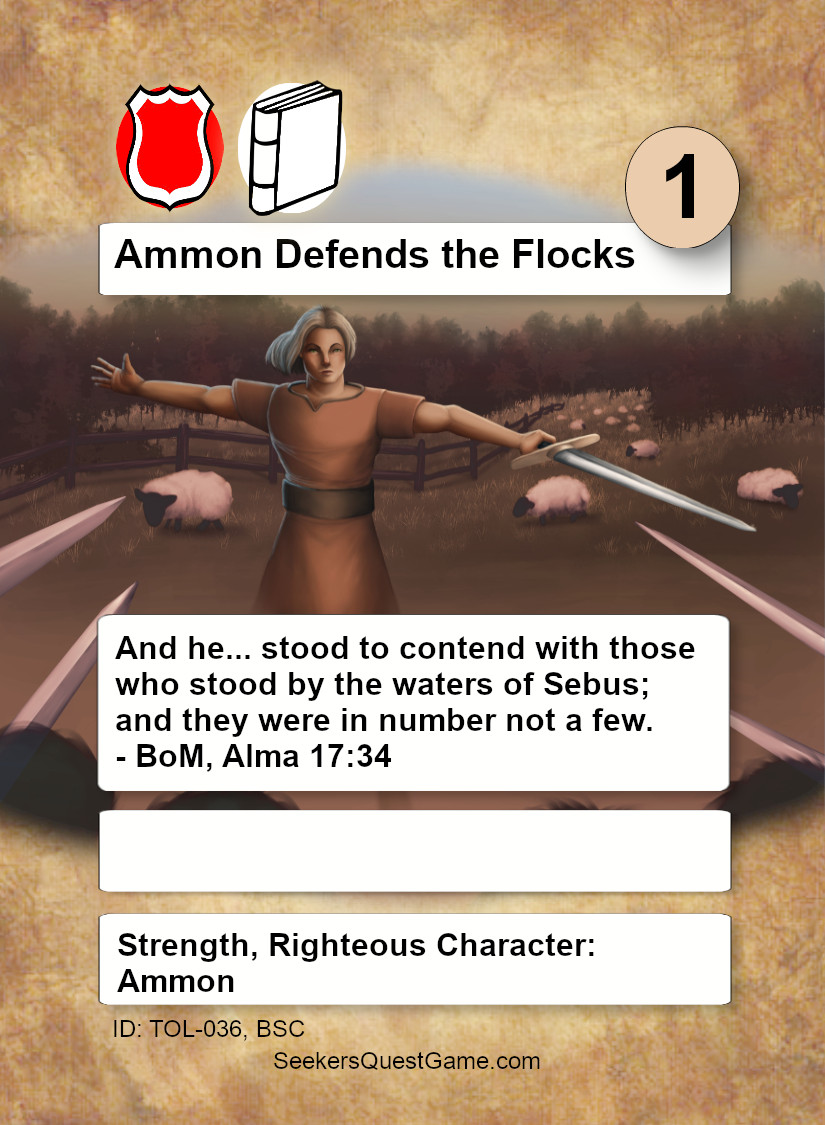
So, my son and I have been working on a new set of cards. We're about a third of the way through the first versions (unplaytested) already. It's all based on the books of Alma, Helaman, and 3 Nephi. We began by choosing 9 stories that we wanted to include specifically. The majority of the verses will be from those. There will be some extras that will fill in gaps.
The stories include:
Alma, Amulek, and the conversion of Zeezrom
Ammon and Lamoni
The massacre of the Anti-Nephi-Lehis
The preaching and death of Korihor
The Kingmen Revolt and the Title of Liberty
The Lamanite Wars and the 2000 stripling warriors
The prophecies of Samuel the Lamanite
The Gaddianton Robbers
The appearance of Christ in Zarahemla
There are some exciting new mechanics and ideas, including the Battle mechanic. Let's face it, most of the last half of the Book of Mormon is wars. There's still some great doctrine in there as well, though.
There are now character verses, which can be either righteous or wicked. There's a new mechanic called Convert, where a wicked character verse can be replaced by the righteous version of the same character.
There are also now location verses, which establish a setting for the chapters they're in. These can give bonuses to certain verses with the same location marker.
I'm very excited, so far!
Mark has a lifelong testimony of the Church of Jesus Christ of Latter-Day Saints (the Mormon Church). Mark also has other sites and blogs, including MarkHansenMusic.com and his Dutch Oven blog.